Sustainability Policy
Purpose
Broadway Initiative is a coalition of the top 20 UK business and trade associations working together with government and NGOs to create the framework and mechanisms needed for business to play its full part in delivering our national net zero and environmental goals. As such, our day-to-day activities are supporting environmental progress. Nonetheless, it is important that we also work to ensure that our environmental footprint is minimised and that we understand what we need to do as a microbusiness to be fully aligned with the economic transition to net zero and nature positivity.
Our goal is to reach a 50% reduction in our emissions by 2030. We recognise that this relies on the decarbonisation of the UKs power grid, and will likely rely on Broadway to offset the emissions from activities that it is incapable of decarbonising. This policy sets out our approach to becoming as environmentally sustainable as possible, and the policies and practices we will adopt to achieve this.

Governance
The COO is responsible for the delivery of this policy which applies to all employees. It has been approved by the Finance & Operations Subcommittee and both the policy and progress against our aims will be reviewed annually by this Committee.
Scope
This policy covers Broadway’s overall environmental sustainability, including GHGs, resource use and nature impacts. In terms of GHGs specifically, our emissions are categorised as follows:
- Scope 1: (ie all direct GHG emissions from activities under our control). We have no Scope 1 emissions, as the business travel that our employees undertake is not done in vehicles/modes of transport directly owned by Broadway.
- Scope 2: (ie indirect emissions from the consumption of purchased electricity, heating or cooling). As a remote organisation without a formal office space, Broadway Initiative does not have direct emissions from purchased energy.
- Scope 3: (ie indirect emissions from supply chains or transport owned/controlled by 3rd parties). Like most organisations we have a range of Scope 3 emissions. Some of these, such as emissions from employee travel or home working, can be quantified, whereas others ie from purchased equipment or events are currently difficult to estimate.
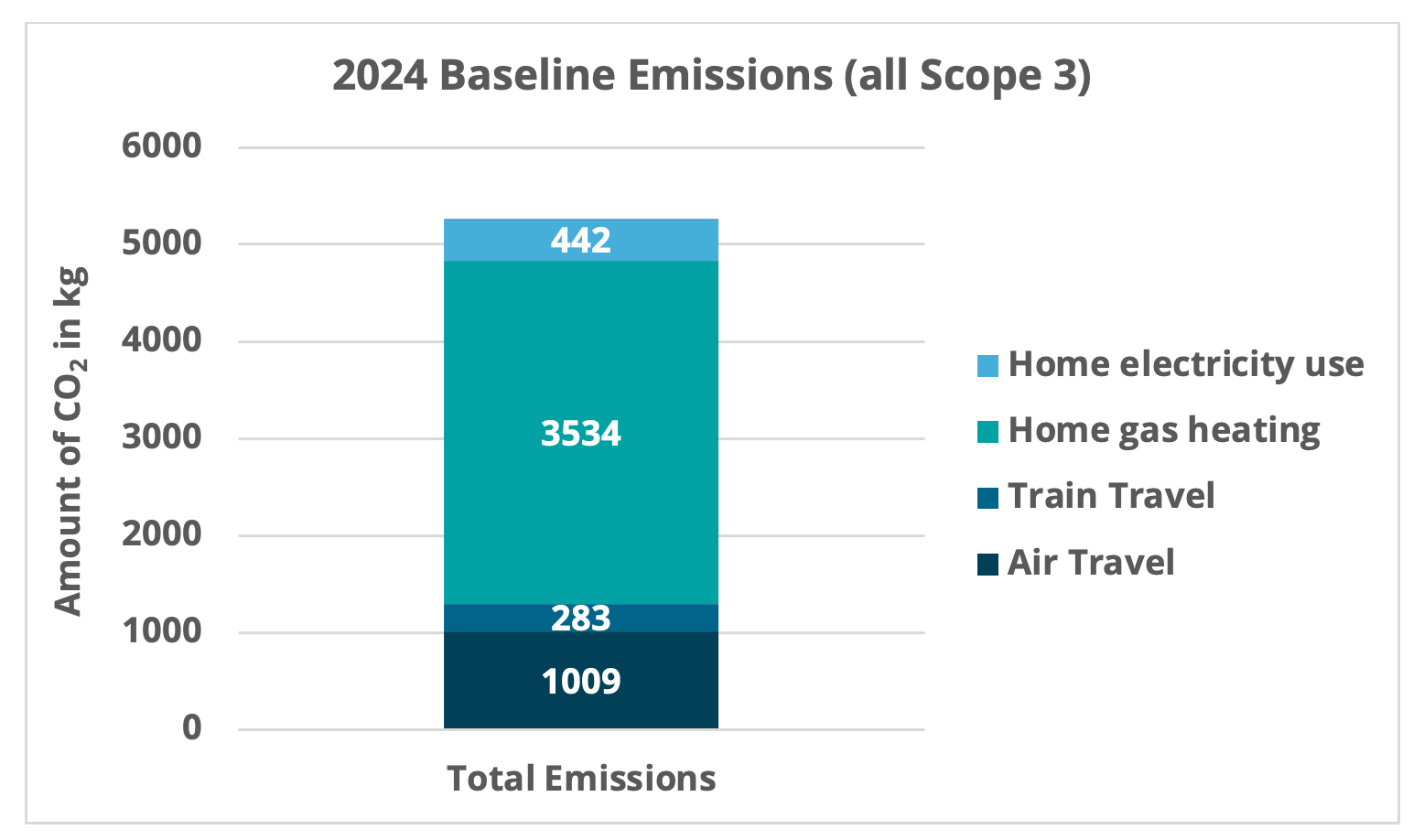
2024 Baseline Emissions
We have taken calendar 2024 as our baseline year and have calculated our total emissions (which in practice are quantified Scope 3 emissions) for that year as 5,269.87kg CO2 (see chart).
Our approach
GHGs: We expect our quantified Scope 3 GHG emissions to fall steadily to 2030 due to external factors such as grid decarbonisation. Therefore, rather than set a hard target for 2030, we will work with our employees on a voluntary basis to collect more detailed data on the emissions associated with their home-working and explore the ways in which a micro non-profit such as Broadway can support employees to take action to reduce such emissions. We will also explore how we can quantify the GHGs associated with our wider Scope 3 emissions, and will consider setting a target for reducing such emissions if it is feasible to do so.
Wider environmental impacts: As with GHGs, we will adopt a twin-track approach of working with employees to support them in having a positive impact on the circular economy and nature recovery, while also minimising the environmental footprint of our supply chains in terms of events, purchased equipment etc.
Our commitment
We are making the public SME Climate Commitment through SME Climate Hub. This commits us to:
- Achieve net-zero emissions by 2050
- Disclose our progress on a yearly basis
In addition, we commit to:
- Better understanding and assessing our full range of Scope 3 GHGs and our non-GHG environmental impacts
- Considering the feasibility of setting a formal target for our Scope 3 emissions
- Identifying and taking steps to reduce these in line with recognised best practice
- Reporting on our progress on these wider goals.
Actions we will take
GHG emissions:
- Staff travel: For business travel within the UK, travel by public transport or EV will be the default option. Exceptions can be made if there is strong business practicality case or personal safety factors – exceptions should be agreed with the COO. It is the responsibility of employees to report the miles travelled each month to the Policy Analyst.
- Working from home: Broadway will proactively engage with staff and provide advice as to ways in which they may mitigate the environmental impact of home working activity.
- Purchased electronic equipment: Only equipment with a C or higher energy efficiency rating will be purchased.
- Data storage: We are exploring whether we can quantify (and then reduce) our GHG emissions from data storage
Resource use:
- Paper use: We do not require staff to make printed copies of documents. Where staff choose to use a printer for home working, only expense claims for recycled paper will be reimbursed.
- Purchased electronic equipment: The purchase of refurbished electronic equipment will be considered whenever available. Staff will liaise with the COO to ensure that all electronic equipment is properly recycled/disposed of at end of life.
Nature:
- Events: Food that is served at Broadway Initiative functions, such as the annual Parliamentary reception, will aim to be as low-carbon or low impact as possible. This will include the inclusion of local food whenever possible. Event venues with a strong sustainability performance will be preferred.
- Staff volunteering day: Staff will be granted one working day a year to participate in nature-related volunteering activity. The aim will be for this to be done as a collective exercise, ie all staff who wish to participate doing so on the same day as part of the same activity/project. The volunteer day will focus on nature restoration or preservation with a designated charity in the UK and will be a chance for staff to use their normal working day to actively participate in improving nature.
Offsetting:
- High-integrity carbon credits will be purchased each year to offset Broadway GHG emissions. Credits representing verified carbon reductions in the UK (for example, Woodland Carbon Credits produced under the Woodland Carbon Code) will be preferred over either ‘promise in kind’ type credits or international credits, though international credits issued through the UNFCCC portal will be purchased if verified UK credits cannot be sourced.
- The Finance & Operations SubCommittee will be required to approve carbon credit purchases.
Monitoring & reporting:
- The Policy Analyst will lead on monitoring and reporting procedures working with the COO and staff.